UK cyber resilience consultation: same framework, faster clock

The UK regulators have told firms what good cyber resilience looks like without writing a single new rule. The week before, Microsoft showed why the tempo matters. It is time to move the clock into the boardroom.
On Thursday 12 November, email stopped working. Not in one firm, but in at least 74 countries at once. For just under 24 hours, banks, brokers and exchanges fell back on telephone and fax. In Singapore some banks could not complete financing deals, and Euronext asked listed companies to phone in urgent market notifications. Nobody had been attacked. Microsoft had a latent defect in its own network gateway, and that was enough.
A week later the Prudential Regulation Authority, the Financial Conduct Authority and the Bank of England published their view of cyber risk and resilience. The consultation contains no new rules. It explains how firms should meet the requirements they already have. Alongside it came two sets of non-binding effective practices, one on artificial intelligence and one on quantum computing.
It would be easy to read that as business as usual. I think the task itself has changed. The framework is the same. The clock is not.
No new rules, a new tempo
The regulators are explicit about the framing. Nikhil Rathi of the FCA said the answer should not always be more rules, and that firms had asked for clarity on what good looks like. So we get principles and outcomes across six familiar functions, from governance to recovery, aligned with the National Cyber Security Centre's Cyber Assessment Framework. The consultation closes on 26 February 2027.
The timing explains itself. October 2026 brought the second-highest monthly number of cyber incidents reported to the FCA in five years. And the AI practices describe why the curve points upwards: AI lowers the cost, the skill and the time an attacker needs. What used to take weeks or months can now take hours or days.
The consequence is the most important sentence in the whole package. Finding weaknesses is no longer the bottleneck. Fixing them is. That is why the regulators ask firms to move from periodic vulnerability management to continuous exposure management, and to prioritise, validate, remediate and recover "at machine speed".
The annual stamp is too slow
Most assurance plans in second line run on an annual or semi-annual rhythm. That made sense when the threat moved at the same pace. It makes little sense when the distance between discovery and exploitation is measured in hours. A review once a year gives the board a stamp. It does not give the board control.
The UK material draws the same conclusion in its own words. Remediation speed and vulnerability backlogs are to be treated as operational risks. Boards should seek assurance that controls actually perform, not only that they are designed appropriately. And reporting to boards and senior management must change in both nature and speed.
This is not an argument for more testing. It is an argument for moving control into the operational everyday. Defining what we need to have under control is, after all, a good deal easier than actually having it under control. The evidence that counts is how long the last critical fix took, how old the backlog is, and whether recovery has been tried for real.
A day without Microsoft
Microsoft's final report on the outage is worth reading for anyone who owns a third-party register. The defect arrived with a change that began rolling out in July. It ran for more than three months without trouble, because load testing had used older hardware than production. It surfaced in November, when extra traffic, reduced capacity and the daily peak happened to coincide. And because the change was months old and already deployed worldwide, the usual quick exits of halting or rolling back could not be used.
Three things follow for the customer. The change was not ours, so no change control of our own could have seen it. The recovery was not ours either, so our tolerance for disruption was set by somebody else's repair time. And the dependency did not sit in the core systems, which largely stayed up. It sat in the workflow around them: confirmations, settlement instructions, approvals. Email is rarely on the map of what an important business service depends on. On 12 November it turned out to be.
This is concentration made visible. In 2025 over 40% of the cyber incidents reported to the FCA involved a third party. The EBA describes common ICT providers as a channel through which disruption spreads from one institution to the next. Since July, Microsoft has been a designated critical third party in the UK, under direct oversight by the same three authorities. That is sensible. Back in 2018 I asked why we did not coordinate the risk assessment of our largest shared suppliers, and Microsoft 365 was one of my examples. But oversight of the provider does not move the responsibility. The Treasury said as much when it made the designation: firms remain responsible for the risks from their own suppliers.
Goodbye to zero-error thinking
Microsoft is among the most competent technology companies in the world, and it could not guard itself one hundred per cent. Neither can we. I have said it before: we should think about cyber incidents the way we think about natural disasters. Anyone can be hit by an earthquake. Anyone can be hit by an outage or an attack. A firm that believes in zero errors does not take the problem seriously enough, and it does not build its risk management in the right way.
November was the benign version. There was no adversary. The AI practices warn that AI-related cyber risk could threaten financial stability precisely where it hits shared resources: critical third parties, common infrastructure, common software. The recovery clock at Microsoft ran for 24 hours. The exploitation clock, on the regulators' own account, now runs in hours.
So the question for the board is not whether it can happen. It is how fast we discover it, how fast we decide, and whether the fallback works when the main channel is the thing that is down. Telephone and fax worked on 12 November, where somebody had kept them.
Find the weak points before they find us
If the clock is the problem, we have to start it earlier. That takes two things most risk functions do not have today: signals from outside, and scenarios that are tested before the day.
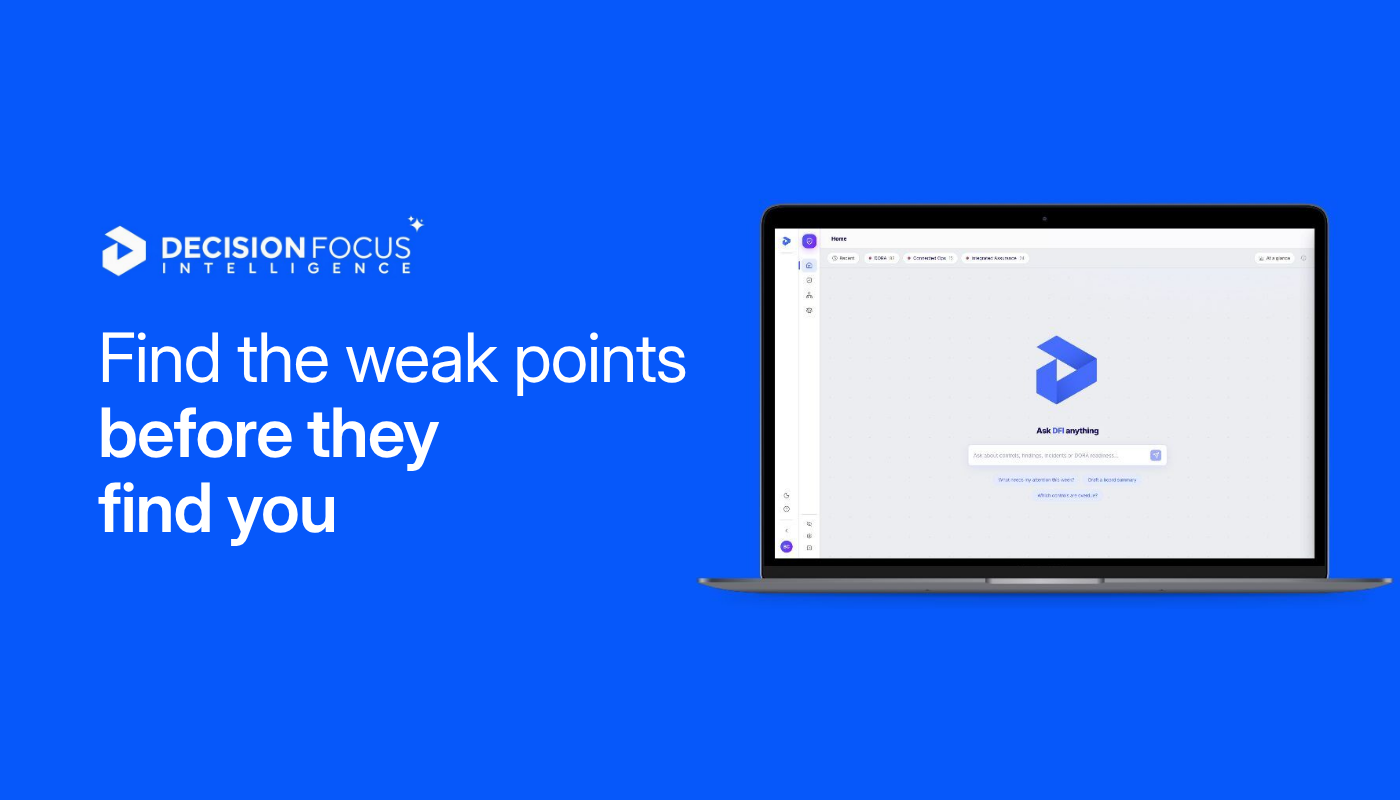
This is what we are building in Decision Focus Intelligence, the agent layer of our platform. Signals is the newest part of it, and it collects what outside sources report: a provider's service health page, a regulator's publication, a threat level, a price. A signal alone means little. So each scenario has a rule with three conditions. If a primary source reports the event. And an independent source confirms it. Here, in our own registers, we are actually exposed. When all three are met, the scenario moves from dormant to active and brings up what is tagged to it: the business services, the suppliers, the controls and the people who own them.
Take 12 November. No signal on earth would have found a latent defect inside Microsoft, and I will not pretend otherwise. But once the service began to fail, the signs were public: the provider's own status messages and a flood of user reports. A firm with a cloud outage scenario tied to those sources gets its affected services, its fallback and its reporting clocks on the table in minutes. It does not spend the first hours asking whether the problem is local.
The larger gain comes before the day. A scenario that can be triggered can also be tested. We run it against the registers as they actually are and let the shock travel: which services depend on the tenant, which of them have a fallback, which fallback has an owner, which control failed its last test. This is where we find out that email carries confirmations nobody mapped, and that the channel outside the platform exists on paper only. Those are weak points we can fix on an ordinary Tuesday.
A failing control matters more when the risk it mitigates is becoming more likely. It is far cheaper to learn that from a test than from an outage. And it is, in practice, what the regulators ask for when they want evidence that controls perform and not only that they are designed.
The signal no longer arrives as law
There is a governance point here that I would make to any board. The two most instructive documents in the November package are explicitly non-binding and not even open for formal consultation. They sit beside a consultation that proposes no new rules. Expectations are being set through guidance, effective practices and published good practice. Not through legislation.
That trade deserves to be named honestly. Firms get flexibility and supervisors get speed, but we lose some legal certainty about where the bar sits. It only works if both sides are disciplined. Regulators owe us consistency in how they apply judgement. We owe ourselves a process that reads the whole supervisory signal. Regulatory change management that follows only legislation will miss the most specific guidance published this year.
Nor is this a matter for banks alone. The UK guidance covers every firm within the existing operational resilience requirements. And the mechanics do not care about sector. An insurer whose claims handling runs on the same collaboration platform is exposed to the same outage as a bank. A pension provider on a concentrated administration platform has the same supplier question a bank has.
What we should do now
We should treat this as a leadership task, not an IT task. The regulators call cyber risk a core business risk and a leadership responsibility. I agree. It cannot be shut inside a small office and handled as a technical question.
We should rebuild vulnerability management as exposure management, with an owner and a budget, and start at the perimeter. We should report remediation speed and the age of the backlog to the risk committee next to the incident count, and time the whole chain from detection to verified fix. Most firms can state their patch policy. Few can state how long their last critical fix actually took.
We should rehearse a day without our main provider. Twenty-four hours without the tenant. Email, collaboration and identity mapped to the services that actually depend on them. A channel outside the platform for crisis management and confirmations. And a decision made in advance about who invokes the fallback, and when.
We should connect signals from outside to the scenarios we already have, and test those scenarios against our own registers before the day. A scenario that lives only in a workshop report does not start any clock.
And we should answer the consultation before 26 February. The regulators have, unusually, told us what they consider good practice before requiring it. That opportunity has a short shelf life. Guidance published as non-binding in November tends to become the benchmark for supervisory conversations long before it becomes a rule.
Sources
- PRA, FCA and Bank of England, CP17/26 and GC26/9: Cyber risk and resilience management (19 November 2026)
- PRA, FCA and Bank of England, Effective practices: Cyber risk and resilience management relating to artificial intelligence (AI) (19 November 2026)
- PRA, FCA and Bank of England, Effective practices: Cyber risk and resilience management relating to quantum computing (19 November 2026)
- Bank of England, Cyber resilience guidance consultation and AI and quantum effective practices (19 November 2026)
- FCA, UK financial watchdogs clarify cyber expectations as attacks rise (18 November 2026)
- FCA, FCA confirms new incident and third party rules to bolster resilience (18 March 2026)
- EBA, EU/EEA banks continue to display resilience amid sovereign debt pressures, borrower vulnerabilities and rising cyber threats, Autumn 2026 Risk Assessment Report (20 November 2026)
- Microsoft, Post Incident Report for incidents EX1550543 and MO1550821, final version of 20 November 2026 (copy hosted by 365 Fanatic)
- Trade Finance Global, Microsoft outage stalls trade transactions (13 November 2026)
- The Asian Banker, Microsoft outage exposes systemic technology dependence (16 November 2026)
- HM Treasury, UK financial system strengthened with new safeguards for major technology providers (10 July 2026)